


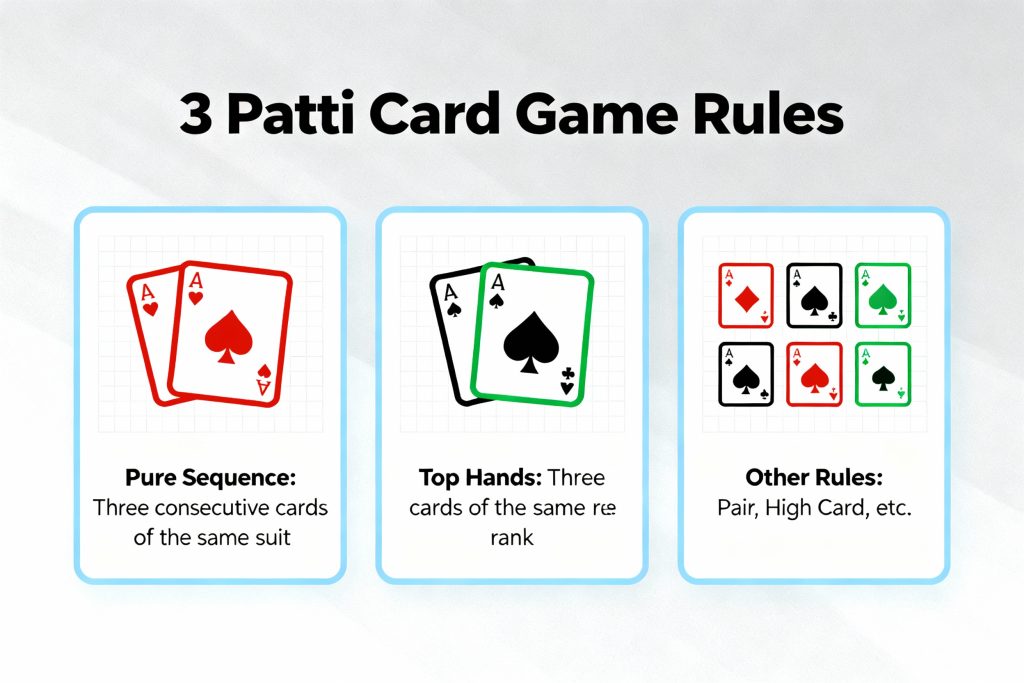
Teen Patti looks simple from the outside – just three cards and a few people betting around a table. But anyone who has actually sat down to play knows that understanding the rules of 3 Patti card game properly is the difference between guessing and playing with confidence. Before you start putting chips on the table, it helps to know how hands are ranked, what a pure sequence in 3 Patti really means, and which combinations are strong enough to bet on.
Teen Patti uses a regular 52-card deck, usually without jokers. Each player at the table receives three cards face down, and the goal is to have the strongest three-card hand according to a fixed ranking system. The game can be played for fun points or for real stakes, but the basic 3 Patti card game rules remain the same. There is a “boot” amount that everyone posts to start the pot, and then players act in turn, choosing to continue or fold based on their cards and their confidence.
At the very top of the hand ranking is the Trail, also known as Trio or Three of a Kind. This means all three cards are of the same rank, such as A-A-A or 7-7-7. Among Trails, Aces form the 3 Patti highest sequence for this category, followed by Kings, Queens and so on down to 2-2-2 as the lowest. Getting a Trail is rare, but when you do, you are usually in a very powerful position to keep betting and build the pot.
Just below Trail is the pure sequence in 3 Patti. A pure sequence (also called straight flush in poker language) is a set of three consecutive cards from the same suit. For example, 4♥ 5♥ 6♥ or 9♣ 10♣ J♣ are pure sequences. Within this category, the highest possible pure sequence is A-K-Q of the same suit, and the lowest would be A-2-3 or 2-3-4 depending on the rules you follow at your table. Pure sequences are very strong and often win big pots, especially when opponents do not suspect you are holding them.
Below pure sequence comes the normal sequence, sometimes just called “sequence” or “run”. This is again three consecutive cards, but suits do not matter. So a hand like 7♣ 8♦ 9♥ counts as a valid sequence even though the suits are mixed. Just like in pure sequences, A-K-Q is the strongest sequence and A-2-3 or 2-3-4 sits at the lower side based on table rules. When two players both have sequences, the biggest cards in 3 Patti combinations are used to break the tie, comparing from highest card downwards.
The next hand in the ranking list is Colour, also called Flush. In this hand, all three cards are of the same suit, but they are not in numerical order. For example, 3♠ 7♠ J♠ would be a Colour. When comparing two Colour hands, the highest card is checked first; if those match, the second and third cards are used to decide the winner. Many beginners misunderstand Colour and Sequence, but the difference is simple: sequence means the numbers are in order; colour means the suit is same.
After Colour comes Pair. A Pair hand includes two cards of the same rank plus one different card, such as 9♣ 9♥ 4♦. Among pairs, A-A with any side card is the strongest, while 2-2 is the weakest. If two players both have pairs, the rank of the pair is compared first; if both pairs are equal, then the third card (kicker) is used to decide who wins. Pair is a very common hand, so pots based on pairs often go to showdown.
At the bottom of the ranking is the High Card hand. This is when your three cards do not form any trail, sequence, colour, or pair. In such a situation, the highest single card decides your strength, followed by the next and then the last. For example, K-10-5 beats Q-J-9 because the King is higher than the Queen. Even though High Card is technically the weakest category, smart betting and bluffing can still turn this kind of hand into a winner if opponents fold better cards.
Understanding which are the biggest cards in 3 Patti across each category is very useful when you start making decisions. Aces are the highest cards overall, followed by Kings, Queens, Jacks and so on down to 2 as the smallest. In most tables, A-K-Q is treated as the strongest sequence or pure sequence, but there are local variations where A-2-3 may be allowed in a circular way. Before you join a serious game, it is always good to confirm these small rule details.
Betting structure is another important part of 3 Patti card game rules. There is usually a minimum stake (boot) that everyone puts in at the start. Players then act in clockwise order, either as “blind” (betting without seeing their cards) or “seen” (after checking their cards). Blind players generally bet smaller fixed amounts, while seen players may need to bet at least double the current stake depending on house rules. A player can fold at any time and give up claim on the pot if they feel their hand is not strong enough.
Some tables include extra options like “sideshow” (asking an opponent to compare hands privately), and different limits on how much the stake can be raised. Online platforms tend to show clear buttons and bet ranges so players are not confused. If you are new, starting with online tutorial modes or low-limit tables is a smart way to get used to the rhythm of betting and folding without risking too much.
Read More: Tips and Tricks to Increase Your 3 Patti Game Real Money
Once you are comfortable with the rules of 3 Patti card game and know how pure sequence, sequence, colour, pair and high card are ranked, you can start thinking about basic strategy. Things like position at the table, the betting behaviour of opponents, and your own risk tolerance should influence your decisions. While Teen Patti has a strong luck element because of the small number of cards, experience and discipline still make a big difference over time.
FAQs:
- What is a pure sequence in 3 Patti?
A pure sequence is three consecutive cards of the same suit, such as 7♣ 8♣ 9♣, and it sits just below Trail in the hand ranking. - What is the highest sequence in 3 Patti?
For sequences and pure sequences, the strongest combination is usually A-K-Q, while A-2-3 or 2-3-4 may be counted at the lower end depending on house rules. - Which are the biggest cards in 3 Patti overall?
Aces are the highest, followed by Kings, Queens, Jacks, 10 and so on down to 2 as the lowest card. - Are the 3 Patti card game rules the same on every app or table?
The basic rankings are mostly standard, but some apps and home games add their own twists, so it is always wise to check the rules section before you start. - How can a beginner learn the rules of 3 Patti quickly?
The easiest way is to start with simple rule guides, watch a few sample rounds, and then practice on low-stake or free tables until you feel comfortable.






Leave a Reply